Brand Consistency: Why It Matters and How to Keep It.
Julio Arango · 11 min read · Updated August 2026

One widely cited industry survey put the revenue lift from presenting a brand consistently across every channel at up to 33 percent. Treat the exact number with care, since it comes from self-reported survey data rather than a controlled study. The direction it points in is the part worth acting on, and it matches what any owner sees in practice: the businesses people remember are the ones that look and sound the same everywhere.
Brand consistency is the practice of presenting the same identity, voice and experience at every point a customer meets you. It is the part of brand strategy that turns brand recognition into loyalty. This guide covers what brand consistency covers, why it pays, the elements it depends on, real examples, and how to hold it steady as your team grows.
What Is Brand Consistency?
Brand consistency means every touchpoint carries the same signals. The logo is the same logo. The brand message says the same thing. The tone of an invoice matches the tone of the homepage. A customer who meets your brand on LinkedIn, then your website, then a proposal, should feel they met one business three times rather than three businesses once. Every way people interact with your brand should agree with every other way.
It helps to separate two things. Your brand identity is the set of assets you own: brand name, logo, color palette, typography, brand story and tone. Applying those brand elements the same way every time is the discipline. Owning a beautiful identity and applying it loosely produces the same result as owning a weak one, which is why brand consistency belongs to operations as much as to design.
A consistent brand is not a rigid one. Campaigns change, formats change, channels come and go. What holds steady is the core brand: the values, the promise, the voice and the visual system underneath the variation.
Why Brand Consistency Matters
It makes people recognize your brand
Recognition is cumulative. A person needs several encounters before a business registers as a real option, and every encounter that looks different resets the count. Consistency ensures each impression adds to the last one instead of replacing it. That is how a recognizable brand gets built on a small budget: repetition, not spend, and brand recognition is the first return you see.
It builds trust
People read consistency as competence. When the proposal, the website and the follow-up email all show the same care, a prospect assumes the same care in the work. Inconsistency raises a quiet question about whether anyone is minding the details, and that question is expensive at the exact moment someone is deciding whether to hire you.
It builds brand equity
This is the premium you can charge because people already know what they are getting. It accumulates only when the experience is repeatable. Each consistent interaction is a small deposit, and each inconsistent one is a withdrawal.
It shortens the sales conversation
When people already know what to expect from your brand before the first call, the conversation starts further along. Loyalty starts here too, well before anyone has signed anything. For an expert-led business that is the whole game: fewer calls spent explaining what you do, more spent on whether the fit is right.
It makes marketing cheaper
Every marketing campaign borrows from the recognition built by the last one. Consistent marketing materials compound, and marketing strategies that reuse a familiar look get more from the same spend. Inconsistent ones start from zero each time, which is why some businesses feel they are always shouting and never heard.
The Key Elements of Brand Consistency
Five things carry most of the weight.
- Visual identity. Logo, color palette, typography, imagery and layout. The most visible layer and the easiest to police.
- Consistent brand voice. Vocabulary, sentence rhythm, level of formality. It drifts faster than visuals because more people write than design.
- Brand message. The positioning, the promise and the proof points. Everyone who speaks for the business should describe it the same way, so the brand image people hold matches the one you intended.
- Experience. How you onboard, how you respond, how you handle a problem. A consistent brand experience is what makes the marketing believable, and this is where brands most often contradict their own.
- Brand governance. Who owns the assets, who approves new ones, and where the current versions live. At any size above one person this is brand management, and it is usually the missing piece.
If you have not defined those elements of your brand yet, our guide to brand identity covers the groundwork, and a brand audit will show you where the current gaps are.
Examples of Effective Brand Consistency
Apple

Apple applies one point of view to the product, the packaging, the retail space, the typography and the advertising. It is brand consistency across every surface a customer can touch. Nothing in the chain contradicts anything else, which is why customers describe the brand in roughly the words the company would choose. The lesson for a small firm is not the budget. It is the refusal to make an exception.
Nike
One mark, one imperative line, and a story about the athlete rather than the product. Nike has run thousands of campaigns without changing what the brand stands for. A global brand earns that scale by keeping the core fixed while the surface moves.
Warby Parker

The voice is the constant here. The same wit shows up in the home try-on flow, the customer service replies and the social posts. It reads as one personality because it is governed as one, which is the harder half of the job.
Everlane
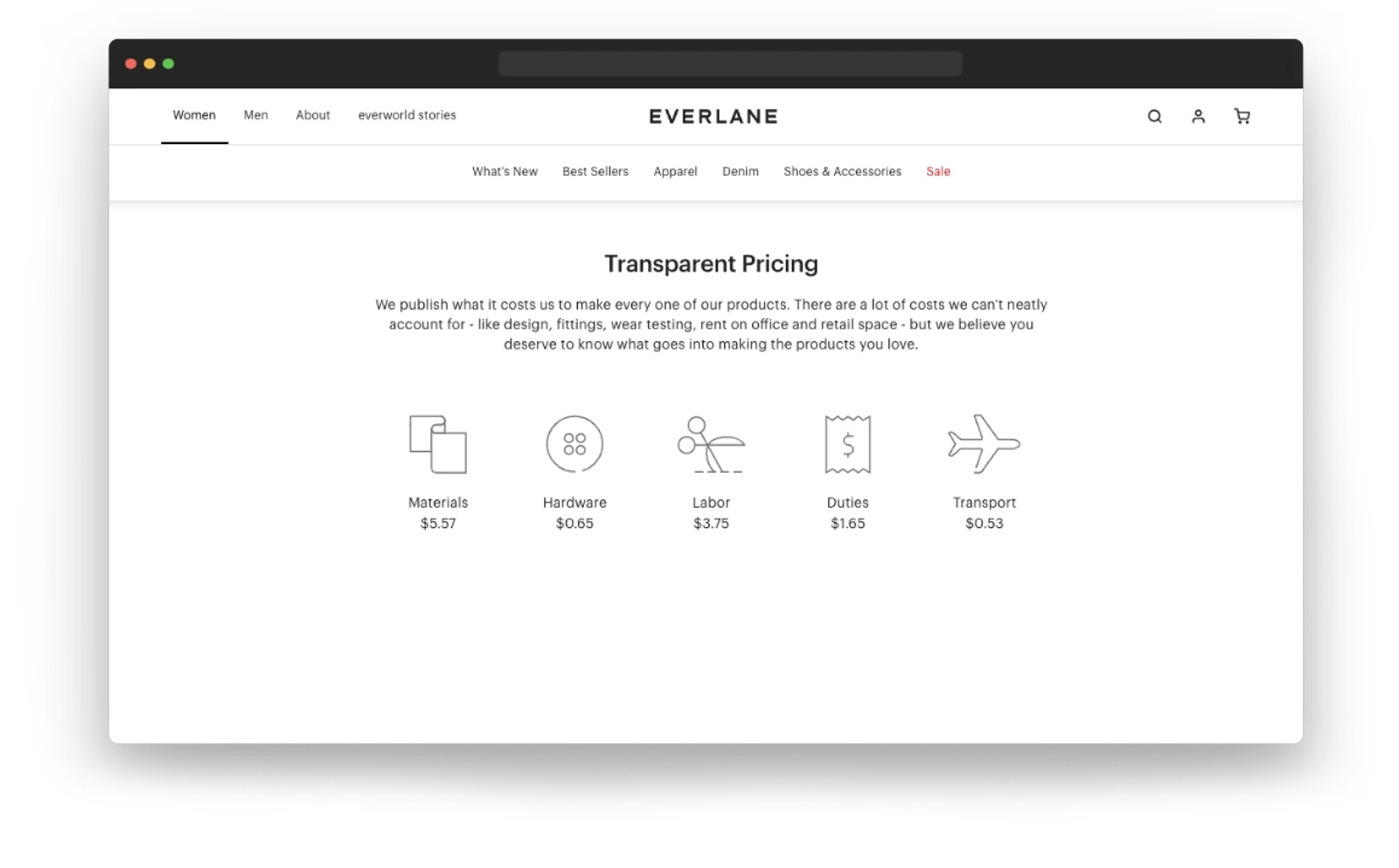
Everlane made transparency the promise and then published cost breakdowns to prove it. What the company says and what it does agree, and that agreement is what customers trust. Agreement between what a brand says and what it does is worth more than matching colors.
Patagonia

The "Don't Buy This Jacket" campaign only worked because it fit a position the company had held for years. Steadiness is what lets a brand take a risk without confusing anyone. A brand that changes shape every season has no standing to say something surprising.
How to Ensure Brand Consistency
1. Write brand guidelines people can actually use
Brand guidelines are the reference that makes this possible when you are not in the room. Use brand guidelines to ensure the answers exist before anyone has to ask. Cover the logo and its variations, the color palette with defined roles, the type system, photography direction, voice with examples, your brand values and target audience, and the mistakes to avoid.
Keep them short. Use brand guidelines to answer the questions a new contractor asks in their first week, not to document every hypothetical.
2. Give the files one home
Most inconsistency is logistical rather than philosophical. Someone needed a logo, could not find the current one, and used the version in an old deck. One folder, clearly named, with the current brand asset set in it, removes a surprising share of the problem. That is how you create a consistent brand without policing anyone.
3. Build templates for the things you make often
Proposals, decks, invoices, social frames and email signatures. A template means the consistent version is also the fastest version, and defaults win over discipline every time. This is the cheapest way to maintain consistency as volume grows.
4. Make it part of onboarding
Anyone who writes, designs or speaks for the business should meet the guidelines in week one. A brand team of one still needs this written down, because the second person you hire inherits whatever you never wrote. Building brand discipline early costs far less than retrofitting it.
5. Review on a schedule
Keeping your brand consistent is easier to verify than to remember. Once a quarter, put your homepage, your latest proposal, your most recent social posts and your last campaign side by side. Inconsistency is obvious in a row and invisible one asset at a time.
6. Measure it
Track branded search volume, direct traffic, and how often new prospects arrive already able to describe what you do. Ask new clients what they expected before the first call. The effort to maintain brand consistency is hard to prove in a single quarter and easy to see across a year.
Common Brand Consistency Challenges
- Growth. Maintaining brand consistency at scale gets harder with every person who can publish. The fix is governance and templates, not vigilance.
- Multiple marketing channels. Each platform has its own format, and formats quietly become styles. Decide in advance what adapts and what never changes.
- Freelancers and agencies. Outside collaborators work from whatever you send them. Send the guidelines first.
- Founder fatigue. You see your own brand far more often than your audience does. Boredom with your own visuals is usually a sign the market is just starting to recognize them. Keep your brand where it is for another year.
- Legacy assets. Old PDFs, old landing pages and old social headers keep circulating. Retire them deliberately, or they will make your brand look like two businesses sharing a name.
Questions About Brand Consistency
What do you mean by brand consistency?
Brand consistency is delivering the same identity, message, voice and experience everywhere a customer encounters your business. It covers what people see, what they read, and what happens when they become clients.
Can you give me an example of brand consistency?
A service firm whose website, proposal template, invoice, email signature and LinkedIn page all use the same logo, the same two colors, the same typeface and the same way of describing the work. Nothing dramatic, applied without exception.
What is the 3 7 27 rule of branding?
It is a rule of thumb, not research: roughly three impressions to notice a brand, seven to remember it, twenty-seven to consider it a genuine option. The numbers are folklore, and the underlying point is sound. Repetition is what earns recall, so an inconsistent brand pays for impressions it never banks.
What are the 7 pillars of branding?
Common versions list purpose, positioning, personality, perception, promise, presentation and persistence. The labels vary between frameworks. What counts is that the first few are decisions, the middle ones are expression, and the last one is holding them over time.
How can brand consistency be measured?
Through recognition signals rather than direct metrics: branded search volume, direct traffic, repeat visitors, referral quality, and how accurately clients describe you to other people. An internal audit of assets against the guidelines gives you the input side of the same picture.
Can smaller companies benefit from brand consistency?
More than large ones, in relative terms. A small firm cannot outspend anyone on impressions, so it has to make every impression count. It is the one lever that improves the return on marketing you are already doing, and it is how a strong brand gets built without a media budget.
Where Consistency Becomes Visible First
Every brand has one asset that gets seen more than the rest. For an expert-led service business it is the website, because it is where referrals go to check you out and where search and AI assistants send strangers.
That is the work we do at Dancing Pels through Custom Websites, where the identity, the voice and the message get built into the structure of the site rather than applied on top of it. Keeping that consistency running across campaigns and channels afterwards is Growth Marketing.
If your assets have drifted apart and you want a straight assessment of where, book a discovery call.